Service Hotline
News
News

Kinghelm SAW Duplexer KH-SAWD1921A: Applicable to LTE and WCDMA Band 1
2026-01-31
10
With the continuous development of mobile communication devices toward higher integration and compact form factors, RF front-end components play an increasingly important role in system design. Among them, duplexers are key devices used to separate transmit and receive signal paths while sharing a common antenna. Their frequency characteristics, insertion loss performance, and isolation capability directly affect the overall stability of wireless communication systems.
The KH-SAWD1921A SAW duplexer, developed by Kinghelm, is designed for LTE and WCDMA Band 1 applications. It is suitable for use in various cellular communication terminals and wireless modules where space efficiency and stable RF performance are required.
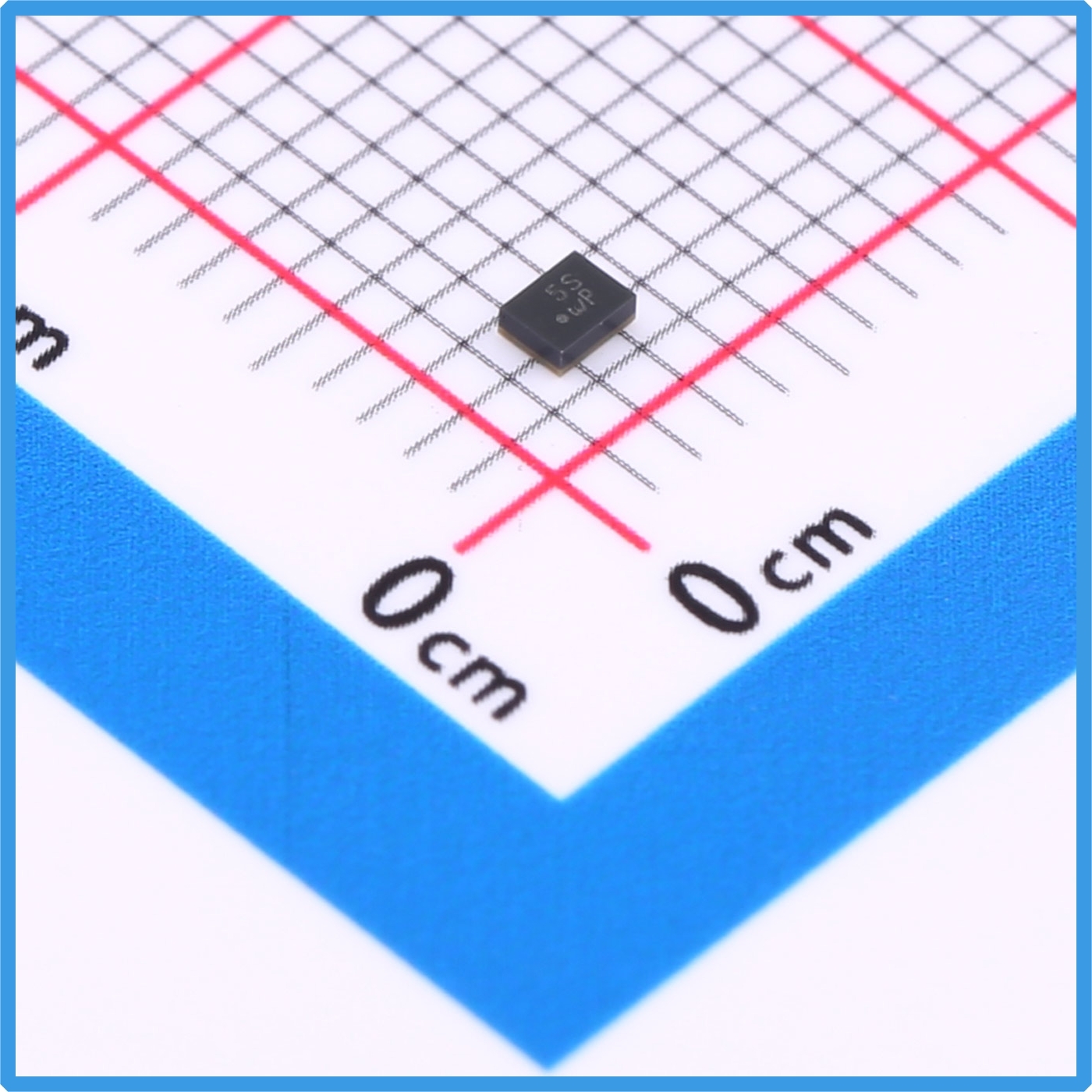
Kinghelm KH-SAWD1921A Product Image
Role of SAW Duplexers in Cellular Communication Systems
In cellular communication systems, transmit (Tx) and receive (Rx) signals typically operate at different frequency bands but share the same antenna interface. A duplexer enables frequency-domain separation of these signals, allowing simultaneous transmission and reception while reducing mutual interference.
Surface Acoustic Wave (SAW) technology is widely used in RF filtering and duplexing applications due to its mature manufacturing process, stable frequency characteristics, and compact structure. SAW duplexers integrate Tx and Rx filtering functions into a single component, making them suitable for space-constrained RF front-end designs.
The Kinghelm KH-SAWD1921A adopts a SAW-based design approach and is optimized to meet the frequency requirements of LTE and WCDMA Band 1 systems.
Product Positioning of KH-SAWD1921A
From an application perspective, the KH-SAWD1921A is positioned as an RF front-end duplexer for Band 1 cellular communication systems. It is typically placed between the antenna and the transceiver circuit to manage signal routing between the transmit and receive paths.
Key design considerations for this model include:
Proper separation of transmit and receive passbands
Controlled insertion loss within the operating bands
Stable passband ripple characteristics
Adequate isolation between Tx and Rx ports
Compact package size suitable for dense PCB layouts
These characteristics make the KH-SAWD1921A adaptable to a wide range of cellular terminal designs.
Electrical Performance Characteristics
When selecting a duplexer, engineers usually focus on parameters such as insertion loss, isolation, and passband definition. The KH-SAWD1921A provides a balanced set of electrical characteristics aligned with common RF front-end requirements.
Within its operating passbands, the duplexer maintains controlled signal attenuation, helping to reduce the impact on transmit power efficiency and receiver sensitivity. The passband response remains relatively smooth, which supports stable signal quality for modulation schemes used in LTE and WCDMA systems.
In addition, sufficient isolation between the transmit and receive paths helps limit signal coupling, contributing to reliable system operation in practical applications.
Package Type and Assembly Considerations
The KH-SAWD1921A is supplied in a compact SMD surface-mount package, making it suitable for modern automated assembly processes and high-density PCB designs.
This package format offers several practical advantages:
Compatibility with standard SMT production lines
Efficient use of PCB space in compact devices
Reduced signal path length, helping manage parasitic effects
Easy integration with other RF front-end components
Tape-and-reel packaging is used to support batch production and automated placement.
Typical Application Scenarios
Based on its frequency coverage and structural characteristics, the KH-SAWD1921A can be applied in various cellular communication products, including:
Mobile devices supporting LTE and WCDMA Band 1
Cellular communication modules and data modules
Wireless data terminals and portable communication equipment
Cellular IoT devices operating in Band 1
In these applications, the duplexer serves as a fundamental RF front-end component responsible for separating transmit and receive signals.
selection and Design Considerations
When integrating a SAW duplexer into an RF design, the following aspects are commonly evaluated:
Compatibility with the target frequency band and communication standard
Impact of insertion loss on the RF link budget
Package size and PCB layout constraints
Operating temperature range relative to the application environment
Matching with antennas, power amplifiers, and other RF components
The KH-SAWD1921A provides clearly defined parameters and a focused application scope, making it suitable for designs that require a balance between size and RF performance.
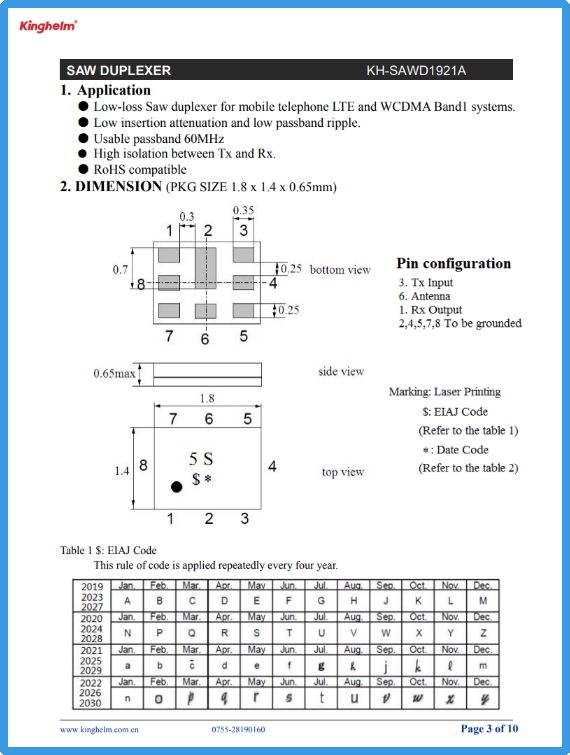
Kinghelm KH-SAWD1921A Specification
Conclusion
As part of Kinghelm’s SAW duplexer product lineup, the Kinghelm KH-SAWD1921A is intended for LTE and WCDMA Band 1 applications. With its defined frequency characteristics, compact SMD package, and stable RF behavior, it can be used in a variety of cellular communication terminals and wireless modules as an RF front-end duplexing solution.
About Kinghelm
Shenzhen Kinghelm Electronics Co., Ltd.(www.kinghelm.net)has technical backbones from Tsinghua University and UESTC, and has introduced overseas returnee professionals. Kinghelm is able to develop highly reliable and high-performance antenna and connector products.KH series products of "Kinghelm" brand include Beidou/GPS antennas, RF adapter connectors, plug connector, electrical data connectors, terminals, and customized vehicle harnesses, industrial / medical connectors, and special antenna connectors."Kinghelm connects world", Kinghelm has grown with the development of China's Beidou industry. Starting from supplying Beidou/GPS dual mode antennas, IPEX terminals, and RF adapter cables for automotive manufacturers, Kinghelm has continuously developed products. Currently, it has a series of WiFi, Bluetooth, NB-loT, LoRa, Zigbee, UWB, and GSM antennas, RFID tags, RF adapter cables, standard microwave antennas, vehicle grade SMA, SMB, FAKRA holders, coaxial cables, and can customize non-standard antenna connectors based on customer drawings or samples.
Related Recommendations