Service Hotline
Resources

Resources
Kinghelm SAW Duplexer KH-SAWD1718A: An Efficient Manager of Mobile Communication Spectrum Resources
2026-01-30
8
In modern mobile communication systems, spectrum is a valuable and limited resource. To achieve higher data transmission efficiency within fixed frequency bands, various multiplexing schemes are employed. Among them, Frequency Division Duplex (FDD) technology allows transmission and reception to operate simultaneously using adjacent but separate frequency ranges, significantly improving spectrum utilization efficiency. One of the key physical components enabling this technology is the duplexer.
Acting much like an intelligent traffic controller, a duplexer allows a single antenna to handle both transmit and receive signals concurrently. It ensures smooth bidirectional signal flow while effectively preventing strong transmitted signals from interfering with weak received signals, thereby forming the foundation for stable and reliable full-duplex communication. The KH-SAWD1718A surface acoustic wave (SAW) duplexer introduced by Kinghelm Electronics is a representative component designed for specific communication bands to support this essential function.
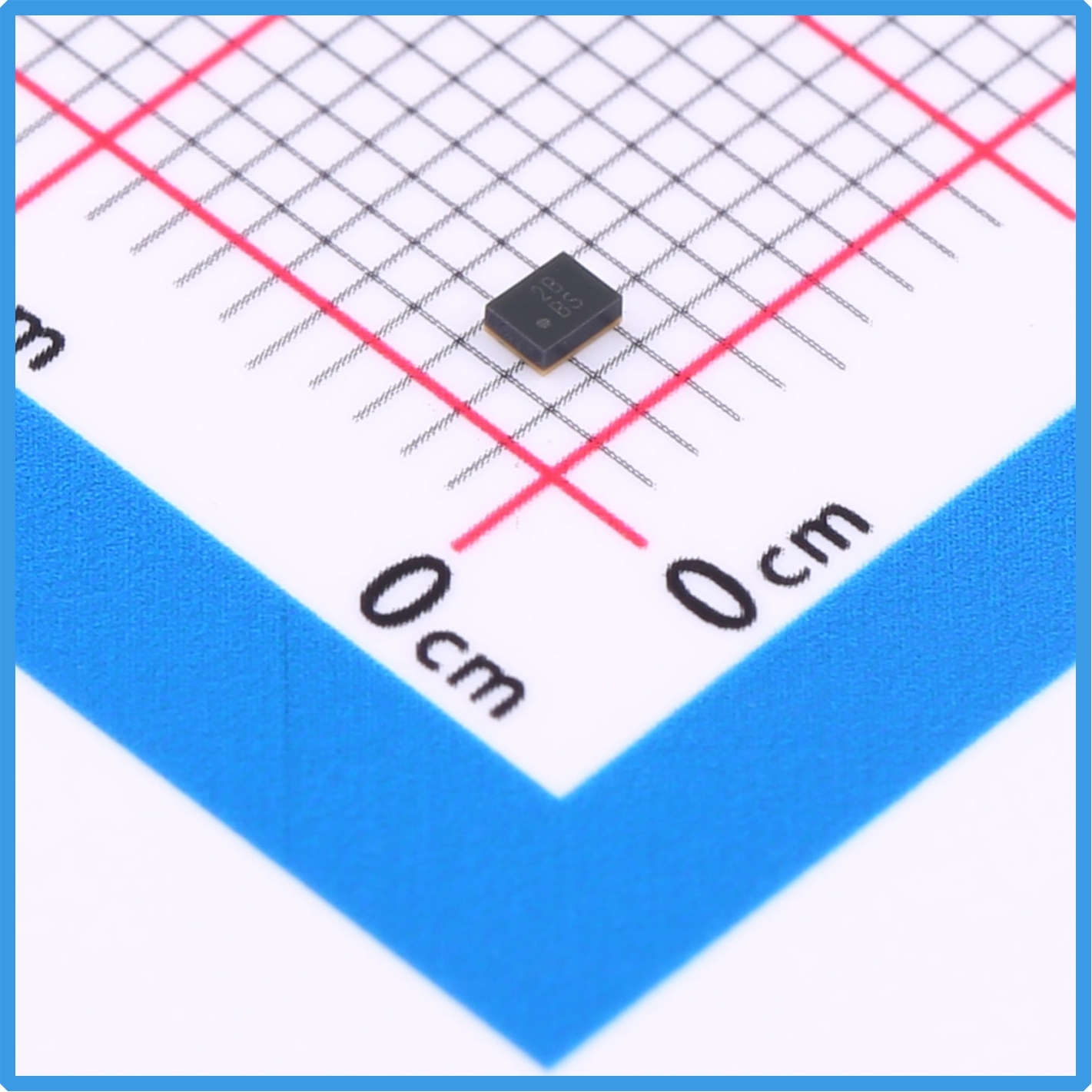
Kinghelm KH-SAWD1718A Product Image
Technical Specifications and Design Characteristics
The Kinghelm KH-SAWD1718A is a SAW-based duplexer primarily intended for mobile communication systems supporting LTE and WCDMA Band 3. It is housed in a compact SMD-8P package with dimensions of 1.8 mm × 1.4 mm, making it suitable for modern mobile devices with strict space constraints.
In terms of electrical performance, the duplexer defines two distinct operating frequency bands. The lower band covers 1.71 GHz to 1.785 GHz, while the upper band spans 1.805 GHz to 1.88 GHz. This frequency allocation corresponds to the uplink and downlink division of the FDD-LTE Band 3 standard, allowing transmit and receive paths to operate simultaneously according to predefined frequency rules. Each band provides out-of-band attenuation of no less than 42 dB, helping suppress unwanted signals outside the operating bands and reducing potential adjacent-channel interference. The passband bandwidth is designed to be 75 MHz, meeting the fundamental bandwidth requirements of the corresponding communication standards.
insertion loss is a critical metric for evaluating duplexer efficiency, as it directly affects effective signal power transmission. The KH-SAWD1718A exhibits a maximum insertion loss of 2.6 dB in the low-frequency band and 3.4 dB in the high-frequency band. Lower insertion loss helps limit power loss along the signal path and contributes positively to maintaining the overall link budget of the device. In addition, the duplexer is designed to maintain good passband flatness, with low ripple characteristics that help preserve signal integrity and reduce distortion introduced by the component itself.
Isolation performance is another core parameter of a duplexer, reflecting its ability to separate transmit and receive signals. The KH-SAWD1718A provides high isolation between the TX and RX paths, minimizing the possibility of strong transmitted signals leaking into the highly sensitive receiver channel. This characteristic helps prevent receiver blocking and provides a solid foundation for clear and stable communication.
Manufacturing Process and Material selection
This product is manufactured using materials and processes that comply with industry environmental requirements and meet RoHS standards. SAW technology utilizes interdigital transducers on a piezoelectric substrate to generate and detect acoustic waves, with filtering characteristics determined by the geometric structure of the electrode patterns. As a result, SAW devices offer stable structures and good consistency in performance. Combined with appropriate packaging techniques, the device can operate reliably over an ambient temperature range of −30°C to +85°C, enabling it to withstand various environmental conditions encountered in daily mobile device usage.
Miniaturized packaging is a clear trend in the development of mobile device components. The small-form-factor package adopted by the KH-SAWD1718A aligns with the space-efficient design requirements of modern mobile terminals. Its tape-and-reel packaging also supports automated pick-and-place assembly, making it suitable for large-scale, high-efficiency electronic manufacturing processes.
Application Scenarios and System Considerations
In FDD-based mobile communication systems, the duplexer is an indispensable component of the RF front end. It allows the antenna port to be shared by the transmitter and receiver, while its internal filtering network ensures that transmitted signals are directed only to the antenna via the TX port, and received signals from the antenna are routed exclusively to the RX port. For FDD-LTE or WCDMA devices operating in the Band 3 frequency range, the KH-SAWD1718A serves as an integrated solution for implementing this frequency separation function.
In practical circuit design, engineers must consider impedance matching, PCB layout, routing, and coordination with other RF components such as power amplifiers and low-noise amplifiers. Proper PCB layout and grounding are critical to achieving the specified performance parameters and preventing electromagnetic coupling interference. At the system level, designers must also evaluate the relationship between the duplexer’s filtering characteristics, insertion loss, and overall RF chain metrics such as gain, linearity, and noise figure, in order to achieve balanced and optimized system performance.
Industry Background and Market Positioning
As mobile communication technologies continue to evolve and spectrum resources become increasingly constrained, RF front-end components are required to meet comprehensive demands in terms of performance, efficiency, integration, and cost. With their mature manufacturing processes, reasonable performance, and effective cost control, SAW devices retain their technical value and market relevance in specific mid- to high-frequency application scenarios. The KH-SAWD1718A introduced by Kinghelm Electronics can be viewed as a technical and product-level response to these specific market needs.
In mobile phones and other portable communication devices, component suppliers must seek appropriate design trade-offs under multiple constraints. The technical parameters of this duplexer reflect an adaptation to the requirements of mainstream mid-band communication systems. Its performance specifications are designed to meet the fundamental requirements of relevant communication protocols, providing device manufacturers with a validated component option when developing products for corresponding frequency bands, and supporting the achievement of expected wireless communication performance.
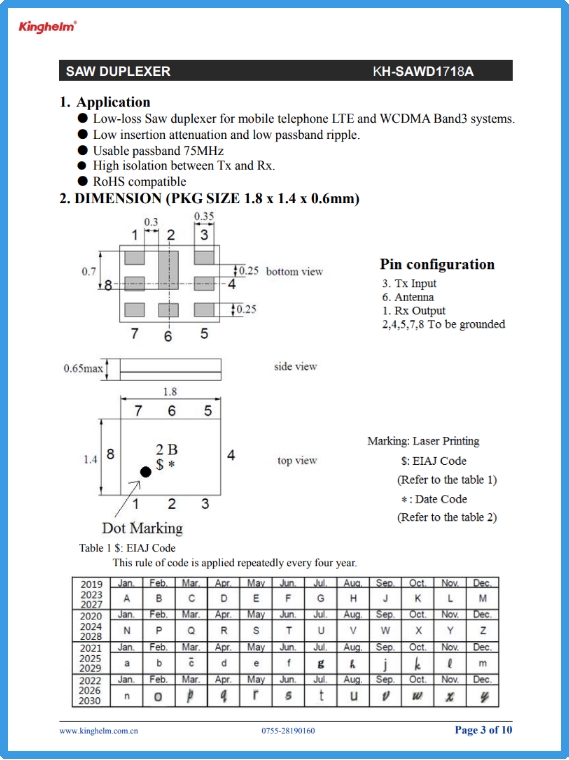
Kinghelm KH-SAWD1718A Specification
Conclusion
The Kinghelm KH-SAWD1718A SAW duplexer is an RF component designed for LTE Band 3 and WCDMA Band 3 systems. Through its internal filtering structure, it provides the necessary frequency separation and signal isolation between transmit and receive paths in mobile devices, serving as one of the key physical components enabling efficient utilization of paired spectrum resources in FDD operation. Its technical characteristics include clearly defined operating bands aligned with system uplink and downlink requirements, insertion loss and isolation performance that meet common design expectations, and a compact package suitable for modern manufacturing demands.
Within the design and manufacturing chain of mobile communication devices, the reliability and applicability of such fundamental components are essential to ensuring overall system performance. For device developers, a thorough understanding of the performance boundaries and application conditions of these components helps inform appropriate selection and circuit optimization, enabling better realization of communication functions within specified frequency bands. As wireless communication technologies continue to advance, RF front-end architectures and component technologies will also evolve to meet future demands for higher frequencies, wider bandwidths, and improved energy efficiency.
About Kinghelm
Shenzhen Kinghelm Electronics Co., Ltd.(www.kinghelm.net)has technical backbones from Tsinghua University and UESTC, and has introduced overseas returnee professionals. Kinghelm is able to develop highly reliable and high-performance antenna and connector products.KH series products of "Kinghelm" brand include Beidou/GPS antennas, RF adapter connectors, plug connector, electrical data connectors, terminals, and customized vehicle harnesses, industrial / medical connectors, and special antenna connectors."Kinghelm connects world", Kinghelm has grown with the development of China's Beidou industry. Starting from supplying Beidou/GPS dual mode antennas, IPEX terminals, and RF adapter cables for automotive manufacturers, Kinghelm has continuously developed products. Currently, it has a series of WiFi, Bluetooth, NB-loT, LoRa, Zigbee, UWB, and GSM antennas, RFID tags, RF adapter cables, standard microwave antennas, vehicle grade SMA, SMB, FAKRA holders, coaxial cables, and can customize non-standard antenna connectors based on customer drawings or samples.
Related Recommendations